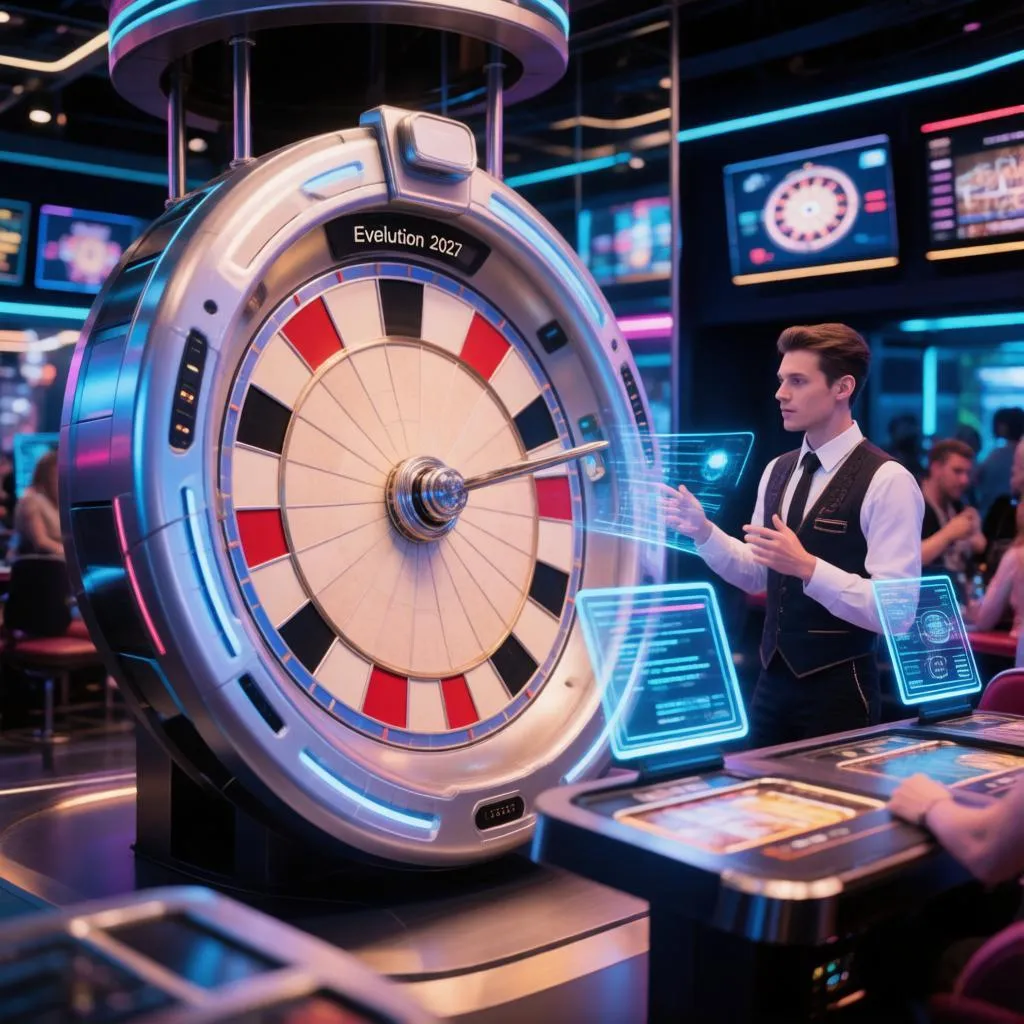
Roulette was never meant to be a spectator sport, yet that is exactly what Evolution has spent eight years turning it into. The Swedish live casino giant — celebrating its twentieth anniversary this year — built an empire on one deceptively simple idea: take the oldest game on the casino floor, wrap it in game show production and bolt a lottery onto every spin. Lightning Roulette opened that era in 2018; Red Door, Gold Vault and FireBall followed; and in 2026 the strategy has gone corporate, with Hasbro’s board games riding shotgun on the wheel. With a roadmap of 119 new titles across the group unveiled at ICE Barcelona in January and new formats landing throughout the year, the next eighteen months will decide what roulette looks like for the rest of the decade.
Where the wheel world stood entering 2026
By the time this cycle began, Evolution’s roulette catalogue had already split into two clear families. The classics — Immersive Roulette, Speed Roulette, French and VIP tables — still carry the full 97.30% RTP of a European wheel and serve players who want nothing but the spin. The showman family is where the growth lives: every recent innovation attaches a bonus layer to a European wheel and quietly pays for it by shaving the straight-up payout, down to 29 to 1 in Lightning Roulette and a bruising 19 to 1 in Red Door Roulette. That second family now includes branded crossovers, player-controlled multipliers, bonus rounds lifted whole from Crazy Time and fireballs that land on pockets mid-spin.
The pressure on this format family comes less from players than from rivals. ICONIC21’s Gravity Roulette lets every inside bet qualify for multipliers of up to 1,000x; OnAir Entertainment’s Diamond Rush stacks ten lucky numbers with a bonus ladder reaching 5,000x; Winfinity’s Cabaret Roulette even extends multipliers to outside bets, a world first. Each rival release raises the ceiling of what players expect a roulette “show” to deliver, and Evolution’s answer in 2026 has been to stop competing on multipliers alone and start competing on worlds — brands, characters, storylines and studios that a rival cannot copy at all.
MONOPOLY Roulette: the wheel meets the board
The centrepiece of the year arrived on 3 June 2026, when Evolution launched MONOPOLY Roulette, the first live casino product from its exclusive Hasbro licensing deal. The base game is an honest European wheel, but after betting closes, a slot-style reel assigns between three and seven MONOPOLY bonus numbers to the layout, alongside Community Chest spots. Land a straight-up bet on a bonus number and Mr. Monopoly walks a virtual 3D board, collecting prizes and multipliers that can stack to 5,000x — with a pass through GO doubling everything on the board. Land on a Community Chest spot instead and you get a quick pick between three hidden cards carrying multipliers of up to 300x.
Two design choices separate this release from every previous roulette hybrid. First, the two bonuses pull in opposite directions: the board game is slow, cinematic and story-driven, while the chest reveal is a five-second dopamine hit, giving the session a rhythm of anticipation and relief. Second, Evolution added Bonus Chaser and Chest Chaser side bets, which automatically cover every qualifying number on the grid — a direct answer to the criticism that hybrid bonuses are too rare to chase deliberately. The reported RTP on standard bets sits a little below the classic wheel, in line with the hybrid family, and the pay-for-the-show trade-off is the same one players know from Lightning: spectacle first, mathematics second.
The Hasbro pipeline keeps rolling
MONOPOLY Roulette is only the first wave of a licensing partnership that Evolution has publicly promised extends beyond 2026, and the slate behind it is unusually deep for a single brand deal. The titles confirmed or previewed at ICE Barcelona paint a picture of where the studio’s creative energy is going:
- MONOPOLY Filthy Rich — described by Evolution as its largest live game show project to date, built across multiple studios within the group.
- Game Night — a multi-game live format bundling several Hasbro properties, including bonus rounds inspired by classics like Snakes and Ladders and Battleships, inside a single studio experience.
- MONOPOLY Roll ‘Em — a dice-led spin-off scheduled for 15 July 2026, extending the board game franchise beyond the wheel.
- A second wave of licensed titles — Hasbro properties developed across Evolution, Ezugi, NetEnt, Red Tiger and Big Time Gaming, with more planned beyond 2026.
What this pipeline reveals is a deliberate shift in strategy: Evolution is buying characters and nostalgia rather than inventing new mechanics from scratch. A branded wheel gives players a story they already know, gives operators an exclusive-feeling lobby headline and gives regulators a familiar, family-safe property to certify — advantages no amount of multiplier engineering can replicate.
Speed, language and the long tail of variants
While the Hasbro games grabbed the headlines, quieter releases are reshaping the everyday roulette lobby. In April 2026, Evolution rolled out Lightning Roulette Speed, an accelerated edition of its flagship that compresses rounds from roughly 25-30 seconds down to 15-20, with a betting window cut to about ten seconds. The multipliers and payout structure remain unchanged, making it a direct riposte to the fast-fire wheels Pragmatic Play and others have used to court younger, mobile-first players.
The other quiet revolution is localisation. Evolution has spent recent years splitting its flagship shows into language-specific editions — Spanish Lightning Roulette streamed from Spain, Lightning Roulette Italia, a Turkish variant and a Brazilian Portuguese version — and in 2025 it launched the Spanish edition of Red Door Roulette, Ruleta Puerta Roja En Vivo, from its Murcia studio. Localised wheels let regulated markets feel like the show was built for them, and they multiply the same production asset across many countries, which is precisely the economics a game show needs to scale.
The formats mapped out
With so many wheels launched and announced within a single cycle, the clearest way to see where roulette is heading is to line the formats up against each other. Each row below is either a confirmed 2025-2026 release from Evolution’s group or an announced date within the current roadmap:
| Format | Rollout | Core twist | What it costs you |
|---|---|---|---|
| Lightning Roulette | 2018 | 1-5 lucky numbers with multipliers to 500x per spin | Straight-up pays 29 to 1 |
| XXXtreme Lightning Roulette | 2022 | Chain lightning and double strikes push multipliers to 2,000x | Even steeper volatility on singles |
| Gold Vault Roulette | 2022-2023 | Up to 20 gold bars stack multipliers to 150x on straight-ups | Reduced single-number payouts |
| Red Door Roulette | October 2023 | 3-15 bonus keys open a Crazy Time wheel worth up to 4,000x | Straight-up pays 19 to 1 |
| FireBall Roulette | April 2025 | Fireballs land on pockets and load multipliers onto inside bets | Lower base payouts than classic |
| World Cup Roulette | June 2026 | Football-themed studio on an untouched European wheel | None — full 97.30% RTP |
| MONOPOLY Roulette | June 2026 | Board game bonus to 5,000x plus chest reveals to 300x | Slightly reduced standard RTP |
| MONOPOLY Roll ‘Em | July 2026 | Dice-led extension of the Hasbro franchise | To be confirmed at launch |
Two patterns run down the format column. The first is that Evolution keeps splitting its roulette output between untouched classic wheels and increasingly aggressive hybrids, so the trade-off never has to be forced on players who want the old mathematics. The second is that the multipliers keep migrating: from straight-up bets only, to all inside bets in rival formats, toward outside bets in Cabaret Roulette — a migration Evolution will almost certainly match once its own engine of multipliers reaches the whole layout.
What the 2027 wave will probably deliver
Official announcements beyond mid-2026 are deliberately thin, but the trajectory of the last three years makes the next wave reasonably predictable. The signals worth watching, in rough order of likelihood:
- More Hasbro wheels — the licensing deal was announced as multi-year, and the pressure to convert board game nostalgia into live lobbies suggests a second branded roulette format is already in development.
- Multiplier expansion across bet types — as rival formats normalise multipliers on splits, corners and even outside bets, Evolution’s straight-up-only model looks increasingly dated.
- More speed tiers — Lightning Roulette Speed proved the appetite for shorter rounds, and a similar treatment for Red Door or Gold Vault is an obvious next step.
- Deeper localisation — more language-specific and country-specific editions of hybrid shows, mirroring the Spanish Red Door playbook in larger regulated markets.
- A Crazy Time successor for the wheel — Evolution’s biggest shows keep feeding mechanics back into roulette, and the next flagship game show will inevitably spawn its own wheel hybrid.
Each of these predictions extends a pattern already visible rather than inventing one, which makes them more useful than rumour-spotting: when a studio has released nine roulette variants in four years, the tenth is rarely a surprise, only a question of how far the multiplier ceiling stretches.
The tax on showmanship
Beneath every new format sits the same uncomfortable constant: showmanship is paid for by the player. Cutting a straight-up payout from 35 to 1 down to 29 or 19 does not create money; it redistributes it, moving value from ordinary single-number wins into the rare bonus rounds that make the show watchable. World Cup Roulette is the revealing exception — a 2026 release with a full 97.30% RTP and no mechanics change at all — because it shows Evolution is consciously serving both audiences: the traditionalists who want the pure wheel and the entertainment crowd who will trade percentage points for a Mr. Monopoly cameo.
The practical takeaway for players tracking these releases is to read the paytable before falling for the studio. A hybrid with a 19-to-1 base payout is a different economic proposition from one with 29-to-1, even when the headline multiplier looks bigger, and the frequency of bonus triggers varies enormously between formats. The formats arriving through 2026 and 2027 will keep multiplying the theatre, but the arithmetic underneath remains the European wheel’s, unchanged and unchangeable — the show is the product, and the house edge is the price of the ticket.
Where the wheel goes from here
Evolution enters the second half of the 2020s with a formula that rivals can imitate but not equal: the widest live roulette portfolio in the industry, a Hasbro partnership that locked up the most nostalgic brands in gaming, a studio network spanning two continents and a release schedule measured in games per week rather than per year. The new formats of 2026-2027 — board game hybrids, speed editions, localised flagship shows and whatever the second Hasbro wave brings — will keep pulling roulette further from the casino floor and closer to television. The wheel itself will not change; 37 pockets, one zero and a 2.7% edge are as fixed as ever. What changes is everything wrapped around it, and in that space, the next eighteen months belong almost entirely to Evolution’s imagination.