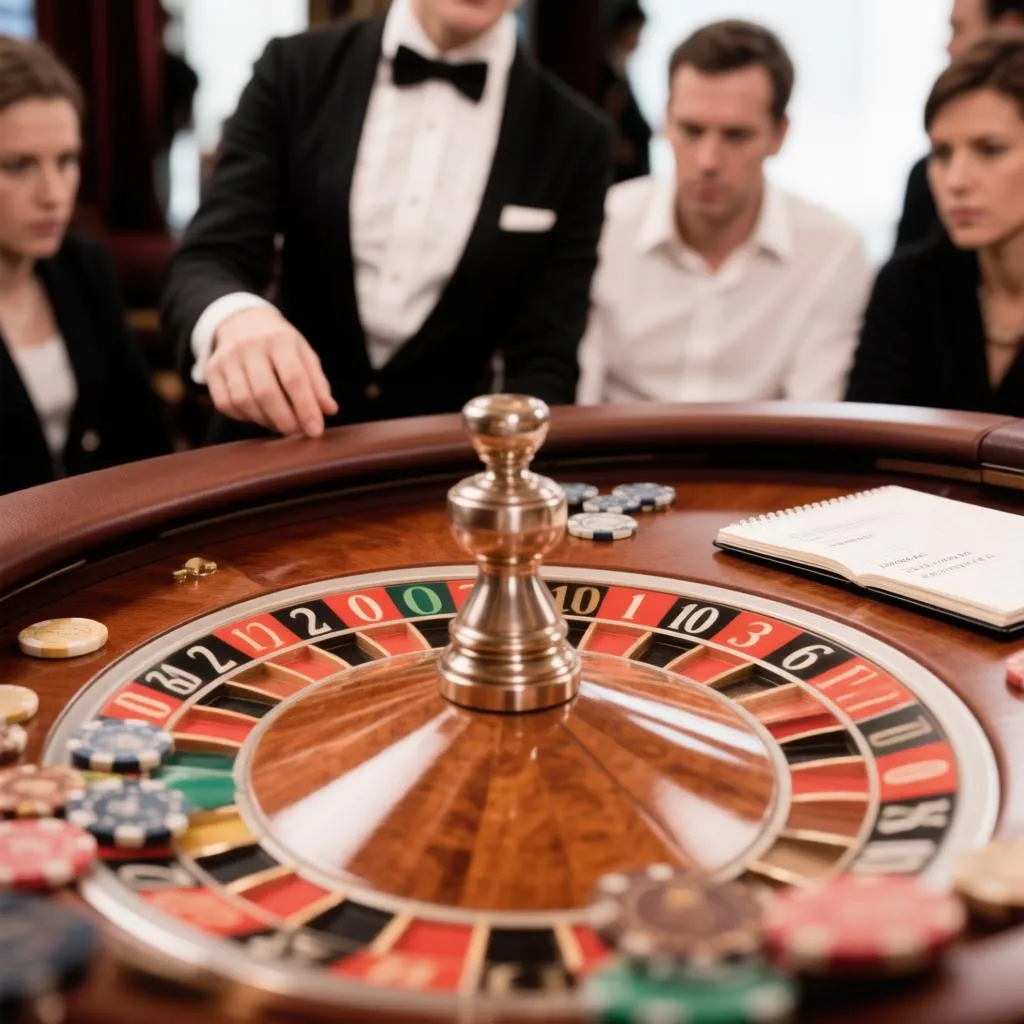
Of all the numbers printed on a roulette layout, one is never shown anywhere on the felt, and it is the only one that truly matters. It is not 35-to-1, the payout that tempts single-number players, and it is not the 37 pockets of the European wheel. It is 2.7% — the house edge — and it operates silently on every single bet placed, on every spin, in every casino on earth. Players can study streaks, track hot numbers, design ladders and bank systems; the edge watches all of it with perfect indifference, collecting its fixed percentage of every unit that crosses the line. Learning what that number really is, where it hides and why nothing invented in three centuries has beaten it is the most valuable knowledge a roulette player can acquire.
Where the edge actually hides
Roulette’s edge is not a trick, a rigged wheel or a conspiracy; it is arithmetic, embedded openly in the payout table. A European wheel holds 37 pockets numbered 0 to 36, and a straight-up bet pays 35 to 1. If the payout were “fair” — matching the true odds — it would pay 36 to 1, returning your stake plus 36 units. The casino instead pays 35, and that missing single unit is the entire business model. Expressed as a percentage, the house keeps 1 unit out of every 37 wagered: 2.7%.
The same deficit repeats across the whole layout. A bet on red covers 18 of 37 pockets but pays even money, as though the chance were 18 of 36. A dozen covers 12 of 37 but pays 2 to 1, as though the chance were 12 of 36. Every payout on the table is calculated against 36 outcomes rather than the 37 that actually exist, and the ghost pocket — the zero — is where the difference lives. American wheels make the point even more bluntly: a second zero raises the house edge to 5.26%, nearly doubling the tax on identical gameplay.
The same tax on every bet
A common belief holds that some bets are “smarter” than others because they win more often. The payout table is carefully engineered to make that belief false. Compare the main bet types by their true chance of winning and what they actually return:
| Bet type | Chance of winning | Fair payout | Actual payout | House edge |
|---|---|---|---|---|
| Single number | 1 in 37 (2.7%) | 36 to 1 | 35 to 1 | 2.70% |
| Split (2 numbers) | 2 in 37 (5.4%) | 17.5 to 1 | 17 to 1 | 2.70% |
| Dozen or column | 12 in 37 (32.4%) | 2.08 to 1 | 2 to 1 | 2.70% |
| Red, black, odd, even | 18 in 37 (48.6%) | 1.06 to 1 | 1 to 1 | 2.70% |
Every row of the table carries the identical 2.70%. A player splitting money between a dozen and a single number, or mixing outside bets with inside bets, is not diversifying risk in any mathematical sense — the expected loss is exactly proportional to the money staked, whatever the ticket it is printed on. The wheel offers the illusion of choice and charges the same fare for every destination.
What the edge means in real money
Percentages stay abstract until they are converted into units, and the conversion is where the edge’s patience becomes visible. The house edge is not charged per session or per hour; it is charged per unit of turnover, which makes it relentless in a way few players appreciate:
- Betting 10 units per spin for 100 spins means 1,000 units of turnover and an expected cost of 27 units, regardless of how the session felt.
- Betting the same 10 units for 1,000 spins means 10,000 units of turnover and an expected cost of 270 — the entertainment has a meter running, and it reads turnover, not profit.
- Chasing losses increases turnover faster than anything else, which is why chasing is the edge’s best customer: it raises the wagering volume that the percentage feeds on.
This is also why “breaking even” is a mirage. A player who wins 500 and loses 500 over an evening has not broken even in expectation terms; they have generated 1,000 units of turnover and donated an expected 27 units to the house along the way. The wins and losses cancel on the scoreboard, but the tax has already been collected invisibly, embedded in every payout that was slightly smaller than fairness required.
Why no system has ever escaped it
Three centuries of roulette have produced hundreds of betting systems, and every one of them collides with the same wall for the same reason. A staking plan can rearrange when and how much you bet, but it cannot change the probability of any individual spin or the payout attached to winning it. Since the edge lives in that gap between true odds and actual payouts, no sequence of stakes can touch it. Each system fails in its own characteristic way:
- Loss-chasing systems — Martingale, Labouchère and D’Alembert — win small amounts frequently and then surrender everything, plus more, when a losing streak meets the table maximum or the bankroll’s end.
- Streak-riding systems — Paroli and its cousins — cap their downside beautifully but still pay the 2.7% tax on every unit wagered, so their frequent small wins average out to the same slow bleed.
- Coverage systems — betting dozens of numbers at once, or the famous “two dozens plus columns” grids — spread chips across most of the layout while every chip still carries the full edge, multiplying turnover and therefore multiplying the expected loss.
The pattern across all three families is identical: the system changes the shape of the results, never their average. This is not a claim about any particular strategy being poorly designed — it is a mathematical theorem. If every individual bet has a negative expectation, any combination of those bets must also have a negative expectation, in exact proportion to the total amount wagered. The only moves that genuinely reduce the edge are ones no system proposes: finding single-zero wheels, playing French rules with la partage on even-money bets, or simply wagering less.
The edge versus the short term
If the house edge guarantees profit, why do players win sessions, evenings and even whole months? Because the edge is a long-run average, and the short run is governed by variance — the random scattering of results around that average. Over 100 even-money spins, the typical swing is about ten units in either direction, dwarfing the expected loss of 2.7 units. Over thousands of spins, the noise grows only with the square root of the number of spins while the expected loss grows in a straight line, so the two curves inevitably cross: the edge’s patient linear climb overtakes variance’s lazy square-root wander. Casinos can afford to lose to any player tonight because they play against every player, every night, forever — and the law of large numbers does the collecting for them.
This timing gap explains the most dangerous illusion in gambling: the winning system. A player who tests a progression over a few hundred spins, or remembers three profitable weekends, has sampled only the variance phase, where almost any staking pattern can look like genius. The edge reveals itself not by beating any one player dramatically but by grinding down every player statistically — which is why the survivors of decades at the wheel are, without exception, the house.
What knowing the number changes
Understanding 2.7% will not turn roulette into a winning game, because no knowledge can — but it transforms the quality of every decision around the game. Players who internalise the number behave measurably differently from those who do not:
- They choose single-zero wheels and French rules over American tables, because the edge itself is the only variable worth optimising.
- They treat every bet type as mathematically equivalent and pick bets for enjoyment rather than imaginary advantage.
- They budget sessions in terms of expected cost — turnover multiplied by 2.7% — instead of hoping for profit they have not paid for.
- They distrust any system whose pitch requires the edge to be suspended, because they know exactly which number it would have to suspend.
- They recognise that walking away ahead, at any moment, is the only way to bank a result the edge has not yet taxed into the average.
None of this drains the fun from the wheel; it concentrates the fun where it genuinely lives. Roulette is a beautiful machine for producing randomness, and the price of admission is published, fixed and modest compared with many forms of entertainment. The trouble begins only when players mistake the price for a puzzle to be solved.
The number that ends the argument
Every roulette debate — about systems, streaks, hot dealers, lucky tables — ultimately reduces to a single question: does any method change the difference between true odds and paid odds? The answer is no, and it was no before the first system was written down and will be no after the last one is forgotten. The house edge of 2.7% on a European wheel is not a strategy to be outsmarted but a fact to be understood, the way a sailor understands the tide. It wins not because casinos are lucky or players are foolish but because it is charged on every unit of action while offering nothing in return, and only two forces can shrink it: playing less, and playing on tables where the wheel has fewer zeros. Everything else at the table is decoration. The one number every player must know is the one the layout never prints — and once it is known, the game finally becomes what it always was: an honest, expensive, thoroughly enjoyable way to buy randomness, whose real cost was never a secret at all.