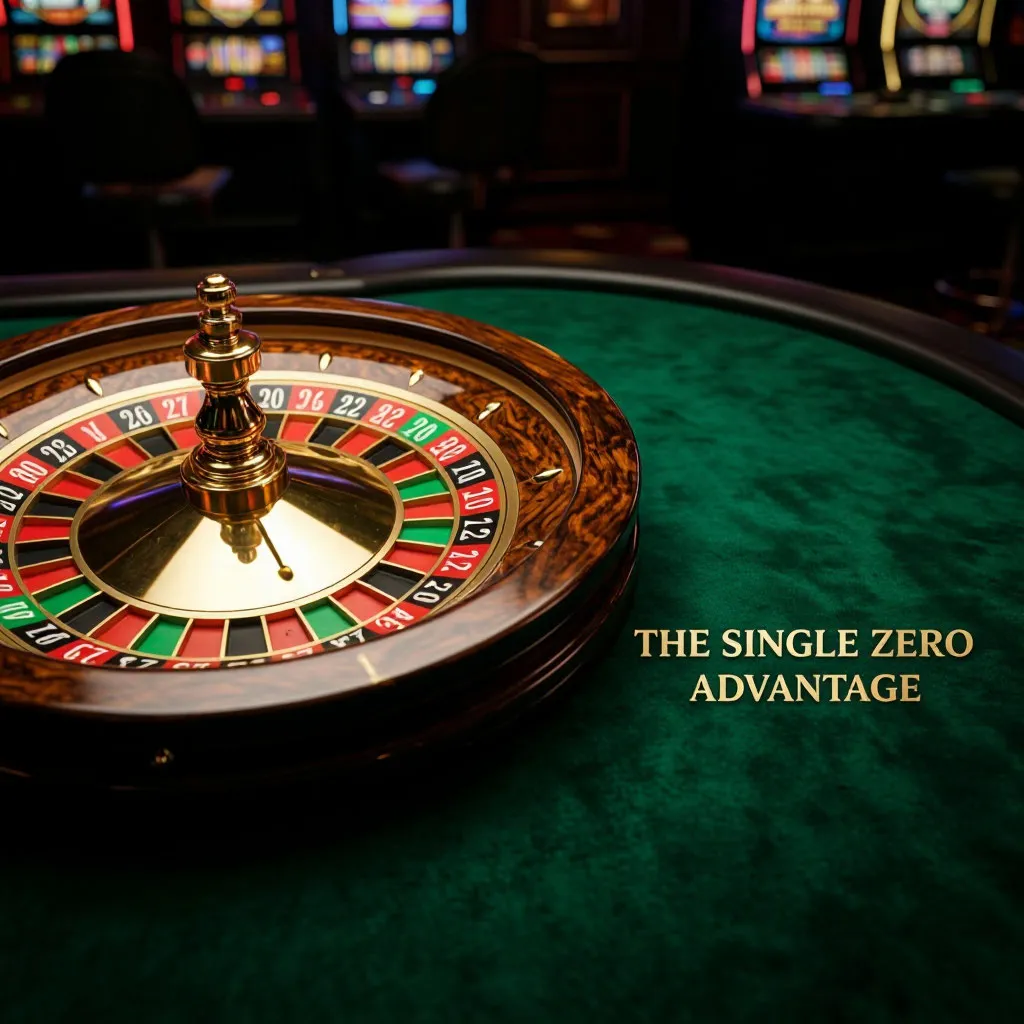
Many casino games rely on flashy lights and complex rules to distract players from the underlying mathematics. Roulette, however, keeps its math in plain sight, painted directly onto a spinning wooden wheel. For anyone trying to figure out how to win European roulette, the journey does not start with complex betting systems or tracking hot numbers. Instead, it starts with a simple choice between two seemingly identical wheels. Choosing the version with a single green zero over its double-zero counterpart is the most critical decision a player can make, representing a massive shift in probability that directly impacts the lifespan of a bankroll.
The hidden cost: how a single pocket doubles the house edge
The layout of a roulette wheel appears straightforward, but the addition of just one extra pocket changes the entire mathematical landscape of the game. On a European wheel, there are thirty-seven pockets, numbered one through thirty-six, and one green zero. The American wheel adds a thirty-eighth pocket, marked with a double zero. While a payout for hitting a single number remains thirty-five to one on both wheels, the actual probability of hitting that number drops on the American wheel. This subtle alteration quietly doubles the casino’s advantage, turning a fair game of chance into a much steeper uphill climb for the player.
Comparing the physics: a direct comparison of both wheels
To understand exactly how this extra pocket drains your bankroll over time, we can look at the cold, hard numbers behind both variations. Comparing the structural differences between these two popular wheel designs reveals why seasoned players completely avoid the American layout in favor of the European standard.
| Metric | European roulette | American roulette |
|---|---|---|
| Total pockets | 37 | 38 |
| Green zero pockets | 1 | 2 |
| House edge | 2.70% | 5.26% |
| Probability of hitting a single number | 2.70% | 2.63% |
| Payout for single-number bet | 35 to 1 | 35 to 1 |
Looking at these figures, the contrast is stark. The single zero layout keeps the house edge at a highly competitive two point seven percent, whereas the double zero layout pushes that edge up to a painful five point two six percent. This means that for every hundred dollars wagered on an American wheel, a player mathematically loses nearly twice as much money over time compared to playing on a European wheel.
The French rules: saving your stakes on even-money bets
The mathematical advantage of the single-zero wheel becomes even stronger when certain traditional French rules are active at the table. These rules are designed to protect players when the ball lands in the green zero pocket, specifically on even-money wagers such as red or black, high or low, and even or odd. If you are playing on a European table that features these specific mechanics, your overall risk drops significantly.
Knowing how these special casino rules operate can help you preserve your bankroll during unexpected zero spins:
- La partage rule: when the ball lands on the green zero, all players who placed even-money bets immediately get half of their stake returned to them.
- En prison rule: instead of losing your bet when the zero hits, your even-money stake is locked in place, or imprisoned, for the next spin of the wheel.
- The prison escape: if your locked bet wins on the subsequent spin, you receive your original stake back in full, though without any extra winnings.
These rules cut the standard house edge of two point seven percent in half, dragging it down to a tiny one point thirty-five percent. This makes even-money bets on a French-style European wheel some of the safest and most player-friendly wagers in the entire casino landscape.
Tactical steps: how to win European roulette consistently
To truly capitalize on the single-zero advantage, players must combine mathematical knowledge with disciplined execution at the table. Merely finding a European wheel is not enough; you must also apply a structured approach to your betting patterns and bankroll management.
To put this knowledge into action and maximize your chances of leaving the table with a profit, consider implementing these reliable playing habits:
- Verify the wheel layout: always double-check the wheel physically or virtually to ensure there is no hidden double-zero pocket on the track.
- Seek out French rules: prioritize online and offline tables that explicitly offer the La Partage rule to protect your even-money wagers.
- Avoid the temptation of exotic bets: stick to high-coverage options like dozens, columns, or even-money bets instead of chasing high-risk single numbers.
- Establish a clear exit strategy: decide on a target profit and a strict loss limit before the first spin, and walk away the moment you reach either.
By following these practical steps, you remove emotion from the equation and allow the superior mathematics of the single-zero wheel to work in your favor. This disciplined approach is what separates casual gamblers from players who understand how to tip the scales back toward their side of the table.
The single zero advantage is not a magic formula or a temporary glitch; it is an undeniable mathematical reality. By choosing European roulette, players immediately eliminate half of the house’s mathematical edge, giving themselves more playing time, better survival rates during losing streaks, and a much higher chance of walking away a winner. Understanding how the wheel is built is the ultimate foundation for anyone serious about mastering this classic game.