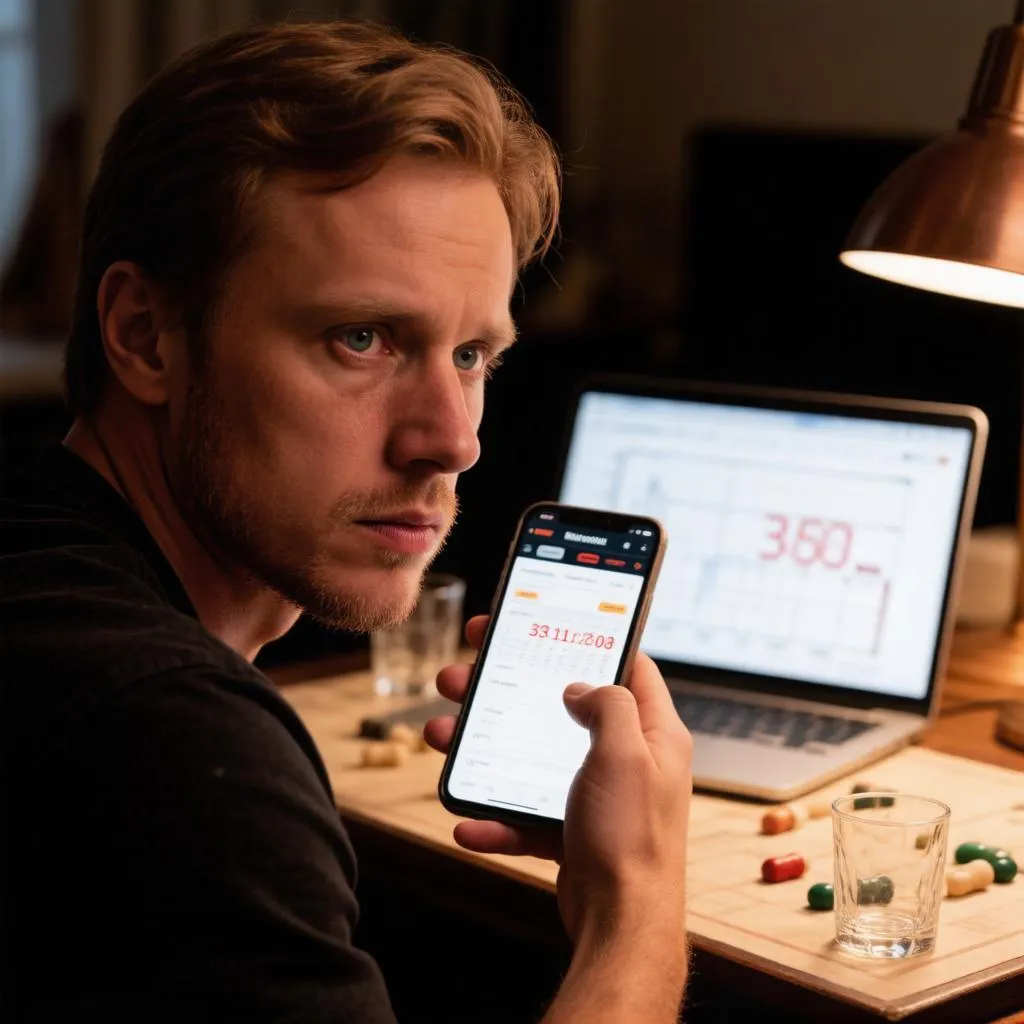
Ask any experienced dealer which players lose the most money, and the answer will rarely be the drunk tourist or the system-bookish mathematician. It will be the calm-looking player who has just lost five spins in a row and is now doubling up with a jaw set like granite. Casinos call this state “tilt”, poker players borrowed the word from pinball machines that physically tilted when shaken, and it is the single most expensive condition in gambling — not because the odds change, but because the player does. Tilt does not attack your bankroll directly; it dismantles the judgement that protects the bankroll, and chasing losses is its most common symptom. Understanding how the cycle actually unfolds, in the brain and at the table, is the closest thing roulette offers to genuine self-defence.
Why the brain treats a loss like an emergency
Human beings evolved to react to loss more sharply than to gain, and roulette exploits that wiring with mechanical precision. Neuroscience describes the reaction with two concepts. The first is loss aversion: losing 100 feels roughly twice as painful as winning 100 feels good, which means a losing session delivers a steadily growing emotional debt even when the amounts are trivial. The second is the sunk cost fallacy: money already lost feels like a promise that must be honoured, so the brain reframes continued play as duty rather than choice. “I have to win it back” is not a strategy — it is the sunk cost fallacy speaking in the first person.
A second mechanism deepens the trap. Gambling losses trigger cravings rather than satisfaction, because near-misses and losses activate the same dopamine pathways as wins: the brain releases chemicals in anticipation of reward, and a roulette spin that almost landed on your number keeps that anticipation alive instead of closing it. Studies of problem gambling consistently find that the most dangerous moments are not the wins but the losses that feel almost-win-like — which is precisely the experience of a split bet missing by one pocket, or a red run interrupted by a single zero. The wheel never needs to cheat, because the player’s own neurochemistry does the work.
How tilt actually unfolds
Tilt is rarely a single moment; it is a process with recognisable stages, and naming them is the first practical skill. The cycle below describes what happens in a typical losing session at the wheel:
- Trigger — a loss that feels unjust arrives: a zero on an otherwise perfect spin, a near-miss, a win stolen by a last-second bounce.
- Escalation — the stake rises, the pace quickens, and bets spread across the layout in search of faster results rather than better ones.
- Tunnel vision — attention narrows to one goal, recovering the money, while time, limits and even the game’s own mathematics disappear from awareness.
- Chasing — each new bet is justified as “getting back to where I started”, a phrase that should alarm the person saying it.
- Impaired decision — stop-loss limits, session budgets and even simple arithmetic fail to register, because the emotional brain has taken over from the rational one.
- Crash and shame — the money is gone, the chase ends in exhaustion, and the shame of the session often becomes tomorrow’s trigger for the next one.
Reading the sequence, two details matter more than the rest. First, the escalation happens before the chasing: the stake creeps up while the player still believes they are playing normally. Second, the final stage feeds the first one, because shame is a powerful trigger, and players who feel humiliated after a session are the ones most likely to return with a “get even” plan — which is tilt waiting for its next victim.
The arithmetic of chasing
Chasing losses fails for a reason that has nothing to do with psychology: roulette’s house edge taxes every attempt at recovery. The numbers make the point brutally clear. Imagine a player down 50 units who decides to win it back on even-money bets at varying stakes. The recovery requirement grows with every failed attempt, and the pattern is unforgiving:
| Deficit to recover | Flat 1-unit attempts needed | Expected cost of those attempts | Time at 45 seconds per spin |
|---|---|---|---|
| 10 units | About 10 | 0.27 units | Roughly 8 minutes |
| 50 units | About 50 | 1.35 units | Roughly 38 minutes |
| 200 units | About 200 | 5.40 units | Roughly 2.5 hours |
| 500 units | About 500 | 13.50 units | Roughly 6 hours |
The table exposes the trap from two sides. Recovering a deficit is mathematically possible — that is what makes chasing so seductive — but the expected cost of the recovery mission grows in exact proportion to the deficit itself. A player down 200 units who grinds back to zero will, on average, pay 5.4 units for the privilege, and will need two and a half hours of continuous play to do it. Meanwhile the standard deviation of the session means most recovery attempts fail, deepening the deficit and triggering the next round of escalation. Chasing is not a solution that fails occasionally; it is a machine that converts deficits into larger deficits, one “recovery” at a time.
The cognitive biases doing the damage
Tilt is powered by a shortlist of well-documented thinking errors, and learning to recognise them by name turns a vague feeling into a specific warning sign. The main suspects:
- Gambler’s fallacy — the belief that a streak of blacks makes red “due”, which misreads independent spins as a correcting mechanism and fuels loss-chasing with false confidence.
- Illusion of control — rituals, timing the spin, “lucky” numbers and confidence in a system all create a sense of influence over a process that offers none.
- Selective memory — the mind replays the sessions that ended in profit and quietly deletes the grind, producing a distorted lifetime record that feels much better than reality.
- Hot-hand thinking — after a few wins, the brain assumes a streak has momentum, which is exactly how Paroli-style chasing begins its dangerous escalation.
- Outcome bias — judging a bet by its result rather than its quality, which trains the player to repeat reckless decisions that happened to work once.
Every one of these biases feels like insight from the inside. That is what makes them dangerous: the player who chases because “red is due” or “the table is hot” is not acting irrationally in their own mind — they are acting on a model of the world that the wheel simply does not obey.
Warning signs before the damage
Since tilt announce itself through behaviour before it announces itself through results, the most useful defence is a personal checklist. Players who can recognise their own escalation early have a real chance to stop it:
- The stake has risen without a conscious decision to raise it.
- Bets are being placed faster than planned, or on numbers and patterns that were never part of the session strategy.
- The phrase “one more to get back to even” has been thought or said at least once.
- The stop-loss limit, if it existed, has been quietly renegotiated to a higher figure.
- Time perception has slipped — an hour feels like twenty minutes, and the clock is avoided rather than checked.
- Emotions have shifted from enjoyment to irritation, urgency or a strange cold focus on the money rather than the game.
Any single item on the list is a nudge; two or more together are an alarm. The practical response is not willpower in the moment — willpower is precisely what tilt degrades — but pre-committed structure: limits written down before the session, a fixed cash amount with no re-up possibility, and a habit of leaving the table the moment a limit is reached, win or lose.
The habits that actually protect players
Research on problem gambling and decades of dealer observation converge on a small set of habits that reliably interrupt the tilt cycle. They are unglamorous but effective:
- Set a loss limit and a win limit before the session — and define them in money, not in units or moods, so no in-session arithmetic can stretch them.
- Withdraw winnings immediately — money transferred out of the playing balance cannot be re-chased, which removes the fuel from the escalation stage.
- Use time limits, not just money limits — because chasing grows with the number of spins, a clock cuts the cycle shorter than any budget can.
- Take a break after any big loss — twenty minutes away from the table, with a walk and no screen, allows the emotional surge to decay before the next decision.
- Never play to recover a previous session — each session starts at zero by definition, and carrying yesterday’s deficit into today’s strategy is chasing by another name.
- Track every session honestly — a simple record of results over weeks rebuilds the accurate memory that selective recall distorts, and the totals rarely lie.
None of these habits changes the house edge by a single unit — that is not their purpose. Their purpose is to keep the player’s decisions in the hands of the rational brain, which is the only part of the mind that understands what roulette actually is.
Where tilt ends and help begins
It is worth drawing the line honestly. Occasional tilt — a bad hour, a doubled stake that should not have been, an evening that ended worse than planned — is part of the normal experience of playing a negative-expectation game. Problem gambling is different in kind: it is chasing that persists across sessions, money borrowed to play, concealment from family, irritability when not playing and limits that fail repeatedly despite genuine intention. Anyone who recognises their own behaviour in that list is not dealing with a strategy problem but with a health one, and the responsible step is support rather than another system — self-exclusion tools, counselling services and gambling support organisations exist precisely for this, and using them is a sign of judgement, not failure.
The final word on tilt
Roulette’s cruelty is not in the wheel but in the mirror. The house edge is fixed, published and modest; the damage players suffer overwhelmingly comes from the moments when they stop being the player who understood it and become the one trying to reverse it. Tilt is the name for that transformation, chasing is its behaviour, and the arithmetic of recovery is its weapon. The players who last — who come back for years, enjoy the game and never fund a casino wing themselves — are not the ones with better systems or stronger nerves. They are the ones who recognised their own tilt early, respected the alarm and walked away while the decision was still theirs to make. The wheel will always offer another spin; the discipline to decline it is the only edge a player can genuinely own.